
AT 250, AMERICA MUST DELIVER WHAT IT PROMISED
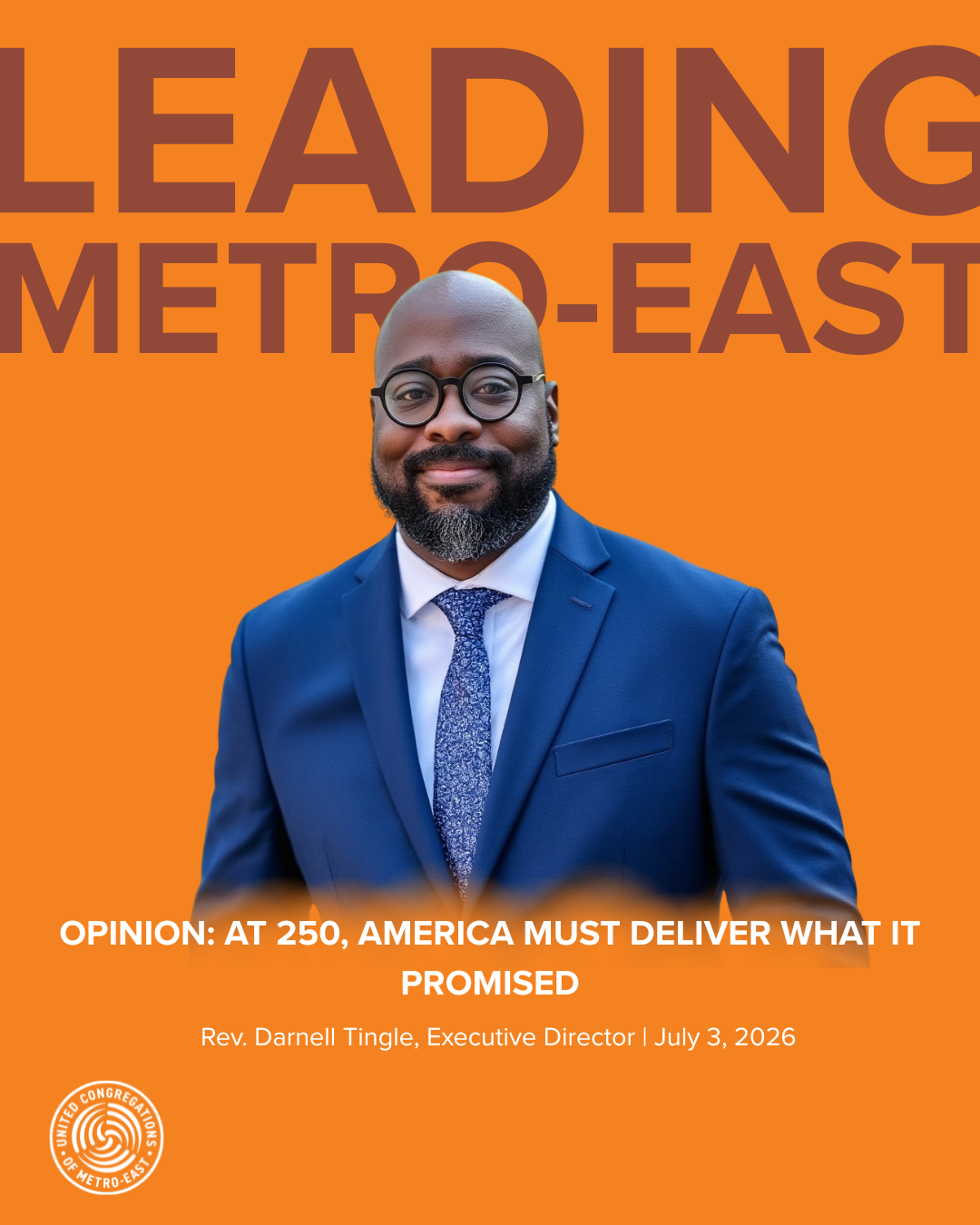
Every Fourth of July, America celebrates freedom.
We gather with family, fire up the grill, watch fireworks fill the sky, and repeat the words of the Declaration of Independence: “that all people are created equal and possess the right to life, liberty, and the pursuit of happiness.”
But as America marks 250 years, celebration by itself is not enough.
As a Black man, a pastor, and a faith-based community organizer in the Metro-East, I cannot think about the Fourth of July without thinking about Frederick Douglass. In 1852, Douglass forced America to confront the gap between what it claimed and how it actually lived. The nation praised liberty while millions of Black people remained enslaved.
Douglass was not trying to make America comfortable. He was trying to make America honest.
That challenge still stands.
“And what does democracy mean when communities are invited to speak only after the most important decisions have already been made?”
What does freedom mean to a family in Cahokia Heights whose home floods with sewage when it rains?
What does liberty mean to a mother in East St. Louis raising a child with asthma near pollution?
What does independence mean to working families struggling to pay rising utility bills while wealthy corporations receive public subsidies and special treatment?
And what does democracy mean when communities are invited to speak only after the most important decisions have already been made?
Those are not questions of disloyalty. They are questions of faith and conscience.
Scripture teaches that the truth can set us free. But truth cannot free a nation that refuses to face it.
Our faith does not allow us to look away from suffering. Micah tells us to do justice, love mercy, and walk humbly with God. Jesus proclaimed good news to the poor and freedom for the oppressed.
That means the church cannot be satisfied with freedom of speech while people are still suffering in the streets.
It is not enough to sing about liberty while communities are treated like sacrifice zones.
It is not enough to praise equality while development is done to people instead of with them.
It is not enough to wave the flag while children breathe polluted air, families endure flooding, and working people are forced to choose between groceries and the light bill.
I have sat with people in the Metro-East who are tired of being told to wait. They have waited on clean water, waited on investment, waited on elected officials, and waited on corporations to do the right thing.
At some point, waiting becomes another name for neglect.
For generations, Black people have pushed this nation closer to its own promise. We prayed when the law was against us. We marched when the streets were dangerous. We organized when those in power told us to be patient. We voted when people worked to deny us the ballot.
We believed midnight would not last forever.
But faith is not passive. It does not sit quietly while injustice grows comfortable.
That is why voting matters.
Voting is not the whole of democracy, but it is one of the sacred tools handed to us through struggle. Our ancestors prayed for the ballot, marched for the ballot, were beaten for the ballot, and in some cases died before they could fully exercise what was supposed to be a birthright.
We cannot honor that sacrifice while treating the act of voting as optional.
Elections determine who writes the laws, who controls public dollars, who appoints regulators, who approves development projects, and who is responsible for protecting our air, water, health, and neighborhoods.
Voting determines whether leaders can ignore the Metro-East without consequence.
But voting cannot be where our responsibility ends.
We must also organize, attend public meetings, ask hard questions, challenge powerful interests, and hold elected officials accountable after the campaign signs come down.
Faith without works is dead, and democracy without participation is weak.
I understand why some people believe their vote does not matter. They have voted before and still watched their neighborhoods struggle. They have heard promises in October that disappeared by January.
But staying home does not punish the system. It gives more power to the people who are already organized, already funded, and already making decisions about our lives.
Our communities cannot afford to surrender that power.
“America’s 250th anniversary should not be treated as one long birthday party. It should be a moment of examination.”
America’s 250th anniversary should not be treated as one long birthday party. It should be a moment of examination.
The question is not simply how long America has existed. The question is whether America has become what it declared itself to be.
Have the poor been heard?
Have the oppressed been lifted?
Have the forgotten been remembered?
Has justice truly rolled down like waters?
Or have we simply become better at celebrating the illusion of freedom while tolerating inequality?
I love this country enough to tell the truth about it.
Patriotism is not pretending everything is all right. Patriotism is loving a nation enough to demand that it repent for its wrong doings, repair what has been broken, and do better.
The flag must never become a curtain used to hide suffering.
The promise of the Declaration does not belong only to the wealthy, the powerful, and the well-connected. It belongs to the child with asthma. It belongs to the family whose basement floods. It belongs to the worker struggling to keep the lights on. It belongs to the formerly incarcerated person trying to rebuild a life. It belongs to every community that has been told to wait while others prosper.
At 250 years, America does not need louder fireworks. America needs a deeper conscience.
We have spent long enough celebrating what America declared.
Now it is time to deliver what America promised.
Here in the Metro-East, that means clean air, clean water, affordable utilities, accountable government, responsible development, and real community participation. It means leaders who understand that our communities are not invisible and our people are not disposable.
I still believe America can become better. But belief without action is empty.
So we must pray, preach, organize, vote, and agitate for justice.
We must trouble the conscience of those who have grown comfortable with injustice. We must refuse to accept neglect as normal or inequality as inevitable.
The question is not whether we will celebrate the Fourth of July.
The question is whether we have the courage and conviction to make its promise real.
Freedom is not merely something we celebrate.
Freedom is something we must demand.
That is what the Fourth of July means to me.
